|
By the time my grandfather died in 2003 of
Alzheimer’s, he’d already been gone from us
for years. It’s hard to remember exactly when I
heard his last war story or the last time I saw that mischievous
grin as he thought of something funny to say.
Or the last time we had a simple conversation uninterrupted
by the disease.
Those had long fallen away, fi rst in fi ts and starts as his
memory slipped occasionally. Then more regularly and
alarmingly, as his mind began playing tricks on him. The
fi rst time I really understood what his Alzheimer’s diagnosis
meant was outside a Mexican restaurant the day I graduated
from high school. We were talking when he casually
interrupted to point at something non-existent behind me
with his trademark grin. “Varmints,” he said. “See those
varmints over there? Better get ‘em.”
His name was Arva Dale Chittum and the varmints
must have been misfi red memories from his childhood
growing up on a dirt farm in the Dust Bowl and Depression
in Piedmont, Oklahoma. With a father who died
when Grandpa was just ten, he had to work early to help
support his mother and three sisters. He enlisted in the Air
Force and flew thirty-three missions over Germany in the
ball-turret of a B-17 Flying Fortress.
For years, the war was something Grandpa didn’t much
like to talk about. It wasn’t until he realized his memories
were slipping away that he started talking to me — the
history buff in the family — about it. The war became
something of an obsession with him, as if he were trying
to remember before he would forget. He told long stories about his time in England and in training in the U.S. that
I wish I’d have written down. I don’t remember much
about them now.
My grandfather’s story is hardly unique. Alzheimer’s
is now the sixth leading cause of death in the U.S. It’s
going to get worse. As the Baby Boom generation gets
older, medical advances are helping it live longer, and that
will result in a wave of Alzheimer’s suff erers. As it stands
now, nearly half of all people over the age of 85 have the
disease. The Alzheimer’s Association says at least one in five
Boomers will get it or another type of dementia.
As the stereotype goes, Grandpa’s generation was stoic,
selfless and tough. It scraped through the Depression, won
a world war and helped launch the country into a period
of unprecedented prosperity. For what it’s worth, Grandpa
fit his generational mold to a T. He fought in the war,
was the first in his family to go to or graduate college
and raised six children in Coffeyville, Kansas, working in a
plant. Later he was county clerk for twenty years.
In the early 1990s, his memory had started to fail him
— first in seemingly harmless ways — like taking wrong
turns on routes he’d driven for forty years. He had always
stuttered, but it got even harder for him to fi nd the right
words, and sometimes he’d just lose his train of thought
completely.
The first really worrisome occurrence happened one
day as he stood in front of the mirror, my grandmother
says. “He said, ‘I can’t tie my necktie.’ Most of the time
he wore a necktie to work. And he never could tie a
necktie after that.”;
Like clockwork, he had always come home from work by 5:30. He started to stay until 8:30 at night and had to go in on weekends because he wasn’t able to keep up with his job. He was afraid he would make a mistake that would result in a big — and humiliating — story in the newspaper.
Finally, his problems got serious enough that my Grandma prodded him not to seek re-election as county clerk, and he retired in 1993. He went to a doctor to get checked out and was diagnosed with Alzheimer’s a year later.
At first, the family tried to keep the fact that he had Alzheimer’s hidden. “Knowing what we know now it was kind of absurd,” says my Aunt Sherri, who lives next door and was indispensable in his care. “But it was kind of protection for him. People liked to visit with him, and I thought they wouldn’t like to anymore. But the absolute opposite was true. And people became even closer to us.”
Sherri is one of six kids, one of whom is my father. Though he’s only fifty-seven, I know that he’s genetically pre-disposed to have the disease. Of Grandpa’s three sisters, only the youngest has escaped the ravages of Alzheimer’s. The other two died of the disease like Grandpa.
I worry that my dad may end up with it. He sometimes pauses when talking as if he’s lost his thought, and my sister and I think he acts funny sometimes, but it’s hard to tell if that’s just a matter of getting older or if it’s even new behavior at all. Still, it’s something my family keeps a somewhat-worried eye out for.
Having seen how it upended my grandparents’ lives, I wonder how my mother could handle it if he were to get Alzheimer’s. How could I justify living 1,500 miles away when she and my sister would have to completely reorient their lives around taking care of him?
Baby Boomers are a much more health-conscious — and perhaps self-conscious — generation than the one that preceded them. A recent study reported that 60 percent of Boomers have experienced short-term memory loss, something that may be innocuous but can also be an earlywarning signal of dementia. The Alzheimer’s Association predicts that the number of Americans living with the disease will soar from about 5 million today to 8 million by 2030 — and double that in 2050.
Who’s going to care for all of the suff erers? It’s hard to
imagine the “Me Generation” putting up with institutionalized
care like their parents and grandparents experienced
in nursing homes. |
| |
|
| · |
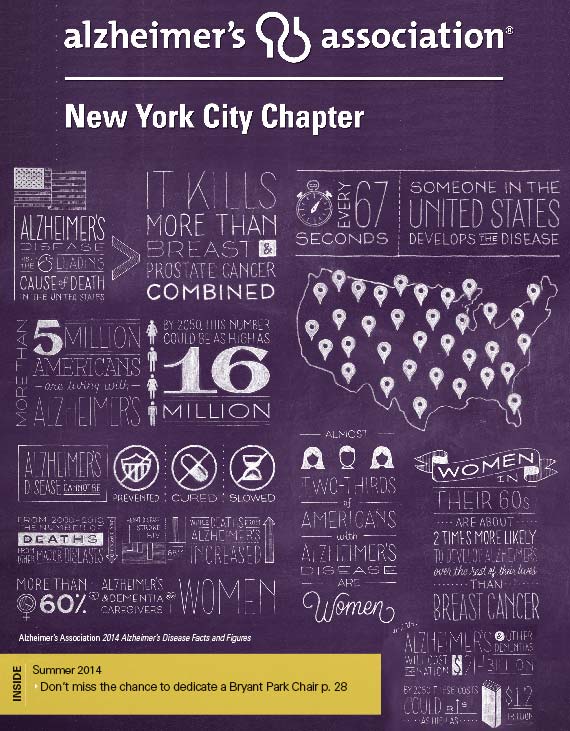
Every 71 seconds someone in the U.S.
develops AD
|
| · |
AD is now the 6th leading cause of death
in the U.S.
|
| · |
Currently, there are 5.2 million Americans with AD,
500,000 under the age of 65
|
| · |
There are 78 million Baby Boomers in the U.S.
|
| · |
1 out of 8 Baby Boomers are at risk of developing AD,
or approximately 10 million people, according to the
Alzheimer’s Association 2008 Alzheimer’s Disease Facts
and Figures
|
| · |
By 2025, there will be 7 million Americans
with AD
|
| · |
By 2050, there will be 16 million Americans
with AD
|
| · |
Medicare is expected to spend $160 billion by 2010 and
$189 billion by 2015 on beneficiaries with AD
|
| · |
Federal funding for AD research has been flat or
declining in the last five years
|
| · |
Medicare and Medicaid spending would decline by more
than $60 billion within 5 years of a discovery of effective
disease-modifying treatments that could delay the onset
and slow the progression of the disease
|
| |
|
| |
Through each phase of life, the Baby Boom generation has
rewritten the rules on social conventions with conviction and
passion. Their voices are needed now to mobilize our nation
in placing Alzheimer’s disease the #1 healthcare priority
and demanding increased funding for research to find better
treatments, prevention and ultimately, a cure. |
| |
|
| |
A CALL TO ACTION |
| · |
Become an advocate to increase public awareness and
national interest
|
| · |
Take part in clinical trials
|
| · |
Come to Albany and Washington, D.C. to lobby for
increased funding
|
| · |
Come to Memory Walk 2008 and recruit friends and family
|
| · |
Fundraise! Fundraise! Fundraise!
|
|
Will my generation be able to handle
the burden and will it be lessened by new medicines? What
will we learn from our parents and grandparents struggles?
Medicare is already overburdened and experts say the
half a million new Alzheimer’s cases a year will just make it
worse. By 2050, as the population ages, that number will
be a million a year.
My grandmother, Edna Mae, refused to put Grandpa
in a nursing home. She took care of him at home, with a
massive assist from my aunts next door and countless acts of
kindness from neighbors and her church community. We
didn’t know it at the time, but it turns out that some seven
in ten Alzheimer’s patients are cared for at home, a huge
and largely unseen burden across the country. Caregivers
face diffi cult, sometimes brutal, work. We as a family worried
often that it might wear Grandma — a remarkable,
indefatigable woman with an optimistic nature bolstered
by her deep Christian faith — out.
She got through the trials in large
measure with her sense of humor about
the situation. We have lots of stories from
that time that still make us laugh. Grandma
took to putting a cowbell around his
neck to make sure she could hear if
he roamed too far. One time my aunt
rounded the corner to see him dipping
French fries into a can of white paint and
eating them. Many mornings he talked
to a picture of a cat on a postcard, an animal he said went
home every night to Yukon, Oklahoma, 190 miles away.
One time Grandma thought he was asleep inside. “All
of a sudden here comes the neighbor from across the street
and she said Arvie’s at my house, and he wants to rent a
room,” she says. “And of all places in the neighborhood
this was not where you’d want to rent a room.”
He’d go to restaurants and talk to people he thought he
knew — but didn’t — and try to eat off their plates. They
called these “Arvie” incidents, laughed at them, and regaled
us with tales of what he’d said or gotten into lately. One
of his most repeated misunderstandings related to what he
thought was a red bull that his mind told him liked to hang
out in a particular corner of the front yard.
But there were also the unfunny times when Grandpa
wandered off or when he fell on her. Or when his increasingly
troubled dreams caused him to fl ail and whack her
across the face in his sleep. She took to sleeping with one
leg wrapped around him and one hand grabbing on to his
nightshirt, in part to keep him from fl ailing, but also to
keep him from wandering off in the night. “Oh, it’s a mean
disease,” she says. But she soldiered on, and as far as I know
never voiced a doubt about whether her choice to care for
him herself was the right one.
In our fi rst-hand experience, Alzheimer’s is a devastating
illness whose impact is multiplied by how dramatically it
aff ects the lives of those around the suff erer. Taking care of
Grandpa was more than a full-time job. It was an aroundthe-
clock responsibility that meant a near-total change in
lifestyle. Grandma couldn’t leave the house without having
someone to keep an eye on him. She learned that it was oftentimes
better to leave him on the ground if he fell rather
than try to pick him back up herself. “I got to where I could
feed him or shave him or lay down there with him,” she says.
But we were also lucky that the personality changes that
so often alter a loved one with Alzheimer’s were never that
dramatic with Grandpa. He was pretty much the same sweet,
good-natured man we’d always known, just increasingly unable to remember our names or how
to do basic things like put on his shoes.
Aunt Sherri remembers the glassy
stare he got when he was seeing things.
One time, “I said ‘what do you see?’ and
he’s looking out the window and he said
‘a jackass.’ I asked if it was an animal or a
human. He said, ‘I’m sure it’s a man because
he’s fooling around with my wife!’ ”
The most haunting thing about
Alzheimer’s is how it trapped Grandpa
in his own mind. Though I never heard him complain, it
was evident at times just how frustrated he was with his
declining faculties. And he had good days and bad days.
On good days we might be able to jog his memory with a
question about his childhood or the war and dig a few words
out of him. A fl ash of recognition would cross his face and
often he would get the twinkle in his eye we knew meant
he was about to say something funny. More and more, the
twinkle would come, but the words couldn’t follow.
His basic values seemed seared into his consciousness.
Up until near the end one sure way to get recognition
from him was to ask him, a teetotaller, if he wanted some
alcohol. “No!” he’d reply emphatically.
But in the last year or so of his life, the bad days came to
dominate. Asking him a question brought no response, as if
he were unable to hear us. He was increasingly susceptible
to infections and had to be hospitalized several times.
I flew home from New York a few days before he died.
He had taken a turn for the worse and I didn’t know if I’d
make it back to Coff eyville in time. He held on for a week
and a half as his body shut down on itself. The disease not
only robbed him — who was otherwise healthy and strong
— of the last ten years of his life, it surely shortened that
life significantly.
It was hard seeing him fall into dementia in his last several
years. But he was always cute, always good-natured
— even in the depths of this terrible disease, one which can
make its affl icted angry and mean.
It’s like it peeled away layers of his mind, until it got to
the core. And there, with a mind like a child’s, we found
him gentle, humorous, and kind. Funny, that’s how we
always knew him as a man.
|
 |
|
Ryan Chittum writes about the business press for the
Columbia Journalism Review. He was a staff reporter
of The Wall Street Journal in New York for several
years covering real estate and recently moved to
Washington with his new bride Anna.
Previous | Next 
|
|